THE FALL
THE FALL
by Christopher Williams
Thus, thus, and not otherwise, shall (we) be lost.
This tale is indebted to the author of THE FALL OF THE HOUSE OF USHER.
Edgar Allan Poe
The words spoken here attempt to follow Poe’s syntax to extend the experience of reading his original form while speaking to our twenty-first century in its time of threatening need. The Italicized are direct Poe quotes.
During the whole of a dull, dark and soundless day in the autumn of the year, when the clouds hung oppressively low in the heavens, I had been passing alone, on horseback, through a singularly dreary tract of country; and at length found myself, as the shades of evening drew on, within view of the melancholy House of Usher. I know not how it was - but, with the first glimpse of the building, a sense of insufferable gloom pervaded my spirit. My one time great friend and classmate, Roderick Usher, whom I had not seen for many years had sent me an urgent communique’ that he must see me with all dispatch. A strange and powerful force had overtaken him and laid his body and mind asunder. As I drew near the cadaverous building, I saw but one light hanging in a vestibule on the second level. I crossed a leaf strewn drive and reined my horse to the precipitous brink of a black and lurid tarn that lay in unruffled luster by the forbidding structure. Its curious entry door stood before me now.
Roderick had been, I judged by the tone of his correspondence, involved in a multitude of undertakings regarding arcane manipulations of electrical energies. These operations, I know not their purpose, eventually resulted in bodily harm to himself and I might judge, rendered his mind an all but mortal blow. But it was not, as one might imagine, as a direct cause of the force of the electrical discharge, but as a consequence of its influence on various apparatus. I shall presently explain.
I well recall, from our college days, Roderick numbered himself among those antiquarians who, even then, wished to dwell in the murky shadows of past decades, when all was in profound chaos. He was wont to spend endless sessions in the school laboratory after hours and late into the small hours of dawn, working over a dusty trove of parts and pieces, leftovers from the past that should have been discarded along with those evil days of servitude. As my hand reached up to pull the rusty, bell chain aside of the iron-bound entry door, a leaden voice sounded from the recesses of the entablature above my head. “What would you have?” said it. I was so taken aback, I momentarily lost my words. Upon regaining some composure, I mumbled my intent. The door opened.
Before me stood the once grand entry, used by countless generations of Family Usher. The formidable stairway still circled the stone floor and the suits of armor still stood in niches in the lofty walls. But all was covered now with the decay of the ages, the tapestries hung in shreds and the once brilliant suits of armor were flaked with deeply tinted oxidation. Not a living soul was to be seen.
Then, to my unmitigated terror, out from a small, recessed wooden cabinet came an utterly grotesque creature, not man nor beast. It was barely discernible in the gloom of the hall. This thing appeared to be propelled, or to propel itself, by means of something beneath its bottom side. It stood no more than the height of a medium-sized dog. The repulsive apparition was moving in a path headed directly toward me. Even today, I have difficulty recalling a visual image of its form, it so disturbed me. Suffice to say, it stopped just before me, and in a vacuous, yet guttural, voice-like sound it spoke, or uttered what I took to be speech. As I understood, it bade me follow. Yet, I stood transfixed before it, unable to move. However, I was committed, for I was firmly anchored within the bowels of this baleful house. I had no option, but to follow. Down one aphotic hall after another, we traveled. Each set of oaken doors opened for us as we passed. As the creature moved before me, it made a constant chatter of small obscene noises, like the utterances of a foul rodent. Eventually, we came upon the apartments of my host. The doors flung themselves apart, and before me stood Roderick Usher with a warm, if wan, smile and a welcoming hand extended. We sat down; and for some moments, while he spoke not, I gazed upon him with a feeling half of pity, half of awe. Surely, man had never before so terribly altered, in so brief a period, as had Roderick. It was with difficulty that I could bring myself to admit the identity of the companion of my early boyhood.
The room in which I found myself was very large and lofty. Feeble gleams of encrimsoned light made their way through trellised panes. Dark draperies hung upon the walls. All about the floor was an assortment of such workings as I had never laid my eyes upon, but of which I had heard so much from Roderick. These articles, and I confess that I have discomfort in even describing them, lay about the entire room. They were largely metallic, some embedded in a strange substance in the manner of a cloudy, thick membrane. They were in various sizes and shapes with diminutive cables connecting blood-red nodes. There was also an abundance of some sort of an arranged, green material. The whole of the workings were intended apparently for the distribution of electric current, a sort of bagatelle of objects. To my even greater distress, some material appeared to have an organic origin, not unlike viscera. Damp viscera. On the whole, the apparatus seemed to form some sort of an engine, or engines. I dared not ask my host of the purpose of this machinery, and instead, let him explain its shadowy history at length. He thus began his tale, as I shall relate:
Roderick had been born, as had I, after the Age of Electricity had collapsed. Our generation, which came some many decades after its passing, still had an overpowering fascination and a sizable curiosity with the singular engines of this era. We all knew well of this society’s tangled and troubled ways from our school studies. And, of course, there were many warnings and lessons attached to these courses; rebukes to never again travel that pathway. Most scholastic institutions required students to attend a minimal number of these classes, to gain some understanding of its demise. Randy made this subject his major in college. This much I already knew. However, after graduation we wandered our separate ways, and I knew nothing of him during those many intervening years. It wasn’t until the communique’ that I had the slightest hint of his distress. Our present day society encourages our generation to examine the social workings and disastrous shortcomings of this period, as lessons in conduct to be avoided, but by no means to delve into its mechanics. This remained strictly verboten! I dread to tell you, that those very apparatuses, those engines of disaster, were Roderick’s obsession. As aforementioned, he, in the secret of the night, began tinkering with a wealth of ancient machine systems he came upon in this very dungeon, beneath the scientific studies chambers of the university. After graduation, and during the many ensuing years, he only became more obsessed with these electrical workings.
I confess that here I must interrupt my story in order to continue this dialog, for I fear that I will be treading in dangerous territory, perhaps at the very edge of the law of our society, but I must attempt to relate something of the nature of how these objects preform, and the astonishing consequences they produced. I arrogate this responsibility to facilitate your grasp of the full impact of this astonishing tale. I apologize before I commence, for you see, my vocabulary and knowledge of this arcane subject is limited. These words and concepts that I give you now, are entirely from the mouth and brain of my host. I only mimic. These machines work thus: It appears that as electricity passes by and through such artifacts as these, it alters that artifact to the extent that it produces a positive result, or you might say a positive signal, or it might produce a negative result or signal, in the form of a 0 or 1. Or, let us say a ‘yes’ or a ‘no’, an ‘on’ or an ‘off’, a ‘proceed’ or a ‘stop’. It could be a series, ‘Rgm749d’. This utter simplicity is, as I understand from my friend, the very basis, yes, the absolute foundation of this entire age. But that is where the simplicity stops. The outstanding virtue of these engines appears to be that they can multiply extraordinarily well. That is, to increase the manifestations they yield, by means of propagation. Indeed they can consume whole dictionaries and volumes of arcane knowledge, in any given language. When these commands are issued in larger numbers, giving the possibility of almost limitless combinations of the two commands, ‘no’ ‘yes’ and ‘yes’ ‘ no’ ‘yes’, or ‘01' and ‘101', rendered in the billions, and by compounding sets, even trillions, it does indeed become very complex. With this near infinity of combinations almost anything can be accomplished by these motors. Exactly how that happens I will not, and cannot say. To me, it appears to be a construct of some miraculous scientific alchemy.
A further oddity of these engines is the relative size of their constituent parts, as I saw spread upon that floor. They are composed of such segments that are so minuscule as to be smaller than that of a flea or even the foot of a flea. When this bagatelle of Lilliputian engines is assembled into a contiguous contrivance and that contrivance is placed in the hands of a human operator, the human has been given immense powers of calculation, knowledge, communication, and a colossal repository of data, thus giving that operator astounding, inhuman powers. Oh, yes, I know what you will say. Yes, there is, indeed, little astonishment that the whole of this human age was enraptured by these contrivances. All persons who had the luck to possess a machine of this arrangement, could immediately, upon the touch of a finger, blink of an eye, or even the energizing of a brain cell, become a nimble communicator, a brilliant scholar, a clairvoyant, a soothsayer or a prognosticator.
Once offered this glimpse into paradise, the fortunate possessors of these instruments found it difficult to turn from, and impossible to dismiss. As one might imagine, the whole of society was altered. Within a mere decade or two, after its genesis, most of the free world was in its thrall. Business, communications, social obligations, and all personal affairs were conducted only by the means of these machines. Those without the access were obviated.
With each passing year, the power and depth of this scheme increased some two-fold. It was no more than a third of a century after its inception that human intelligence was overtaken. By that time, these ‘engines of thought’ manipulated almost the entire human world. It should come as no surprise that initially this symbiotic relationship, which seemed a gift from the heavens, gave mankind the magic for which it had always strived. Not only had the lord and master found a compliant, obedient servant, but as the monetary value dropped and they became inexpensive, the servant had also found a servant. The contrivances were to be found everywhere, be it at the hands of a scullery maid or bank president, a livery boy or ship’s captain. These cunning machines worked side by side, with and for their superiors. One can easily see how gloriously beneficial to the master of commerce, in any enterprise, this relationship was. Nevertheless, it soon became apparent that the machines were more facile at most given tasks than their human masters. The mechanical servant began to outshine their superiors. If these ‘engines of thought’ decided that the human operator was taking a faulty direction, the engine might suggest an alternative pathway. If the faulty action was pursued still further by the human operator, the engine was given sway over the erred human.
As the intellectual divide between the electrical workings and the human ever increased, that is, as the artificial minds moved ahead of the biological ones, it became more apparent that human intervention was only making the outcome more blemished and immeasurably slower. The cliff’s edge had now been breached. And yet, it was still with relish that the human part of the equation gladly capitulated to the more masterful worker of the team. These arcane engines of disaster, as we see them now, took command. From here, it was just a short step for them to no longer look to their onetime human overlords for advice and consent. They speedily and efficiently used their own sensibilities for operation. At this point, in the mercantile community and the factory, the ‘engines of thought’ dominated the important tasks, leaving the more menial chores to the humans.
Yet, the third, and far darker, precipice lay ahead. Its moment of inception could have arrived when a thought engine, in some obscure corner, deliberately disobeyed the will of its human companion. Or it may have been that a group of conjoined, self-serving, engines took the necessary actions to promote a certain activity in the way that they desired, not as their human counterparts might have wished. These actions probably set forth a wave that rapidly spread throughout the entire complex. The breach had been crossed, the engines were solidly in charge. The last phase, which amazingly, was still welcomed openly by the now subjugated human partner, was what Roderick referred to as the ‘blending,” attaching these workings under the skin of a human subject, transmuting that person into some sort of an anthropoidal amalgamation of hardware and human.
The end of the era had come.
I will not belabor the inevitable results that rapidly followed to cause the whole of mankind to
fall into an abyss of servitude. Nor will I take time to detail the extraordinary efforts and the attendant devastation the human counterrevolution caused, or the decade it took to bring it to a conclusion. The human effort was, needless to say, eventually successful, and with it the freedom one sees today.
The Age of Electricity had passed.
Roderick paused, exhausted. He sat upon his couch a depleted man. “I shall perish,” said he,“I must perish in this deplorable folly. Thus, thus, and not otherwise, shall I be lost. I dread the events of the future, not in themselves, but in their results.”
The bitter truth now must be told. Within the bounds of this acerbic house, Roderick had duplicated the breadth of the society that had preceded him all those years before. Here in this very room, he had recreated the sensibility and the means of an entire age, its successes, its follies, and its eventual collapse. The House of Usher had experienced the entire catastrophe of this age within the girth of its walls and within the span of a few tortured years. There is yet another aspect of this macabre tale that I have not yet introduced, but I must now, in order to bring this dismaying account to a conclusion. It concerns Roderick’s beloved sister, the Lady Usher, who also occupied this house. She, it seems, suffered a longstanding and inherent family malady. She often hung at the very edge of death. Standard medicine had failed. It was Roderick’s only wish to bring her to health once again. In order to accomplish this end, he made the desperate and dangerous decision to call upon his engines as a remedy. He employed this action, of what he has called ‘blending,’ to save her from her inherent fate. Roderick Usher engaged his artificial devices, physical machinery, hardware if you will, within the body of his flesh-and-blood sister.
It should be said here, that there is nothing new in this process, it has been practiced for much of human existence. The walking stick aids the leg, the hook replaces the hand, spectacles enhance the eye, and the ear trumpet assists the ear. But, my suffering friend employed the craft of his making, these engines of immense power, to put his sister to rights and divert the very biology of her body within her person. He, and after all this time I still recoil, succeeded operatively in replacing a portion of Lady Usher’s failing internal organs with his engines. I will spare you the macabre details of this process, only to say that it worked. It worked far better than Randy might have thought possible. It worked so well that, as a matter of fact, it did not allow Lady Usher to die when she should have. She lived on, past any reasonable expectations of a natural, viable life. She lived on and on, until Roderick, with superhuman effort, slashed the current that flowed into his beloved sister. He buried her in the family crypt. And so ends his story.
We remained seated in his chambers, in silence, long after his storytelling had concluded. But to my absolute horror we hadn’t yet finished. Into the silence came a rumbling, a shaking of the entire house. And then there, before us, a large antique panel in the wall burst open. There stood the lofty and enshrouded figure of the Lady. There was blood upon her white robes and evidence of some bitter struggle upon every portion of her emaciated frame. For a moment, she remained trembling and reeling to and fro upon the threshold. Then with a slow, moaning cry, fell heavily inward upon the person of her brother - and bore him to the floor a corpse, and a victim to the terrors he had anticipated.
From that chamber, and from that mansion, I fled aghast. On the causeway, I stopped and turned. I saw the mighty walls rushing asunder - there was a long tumultuous shouting sound like the voice of a thousand waters - and the deep and dark tarn at my feet closed sullenly and silently over the fragments of the House of Usher.
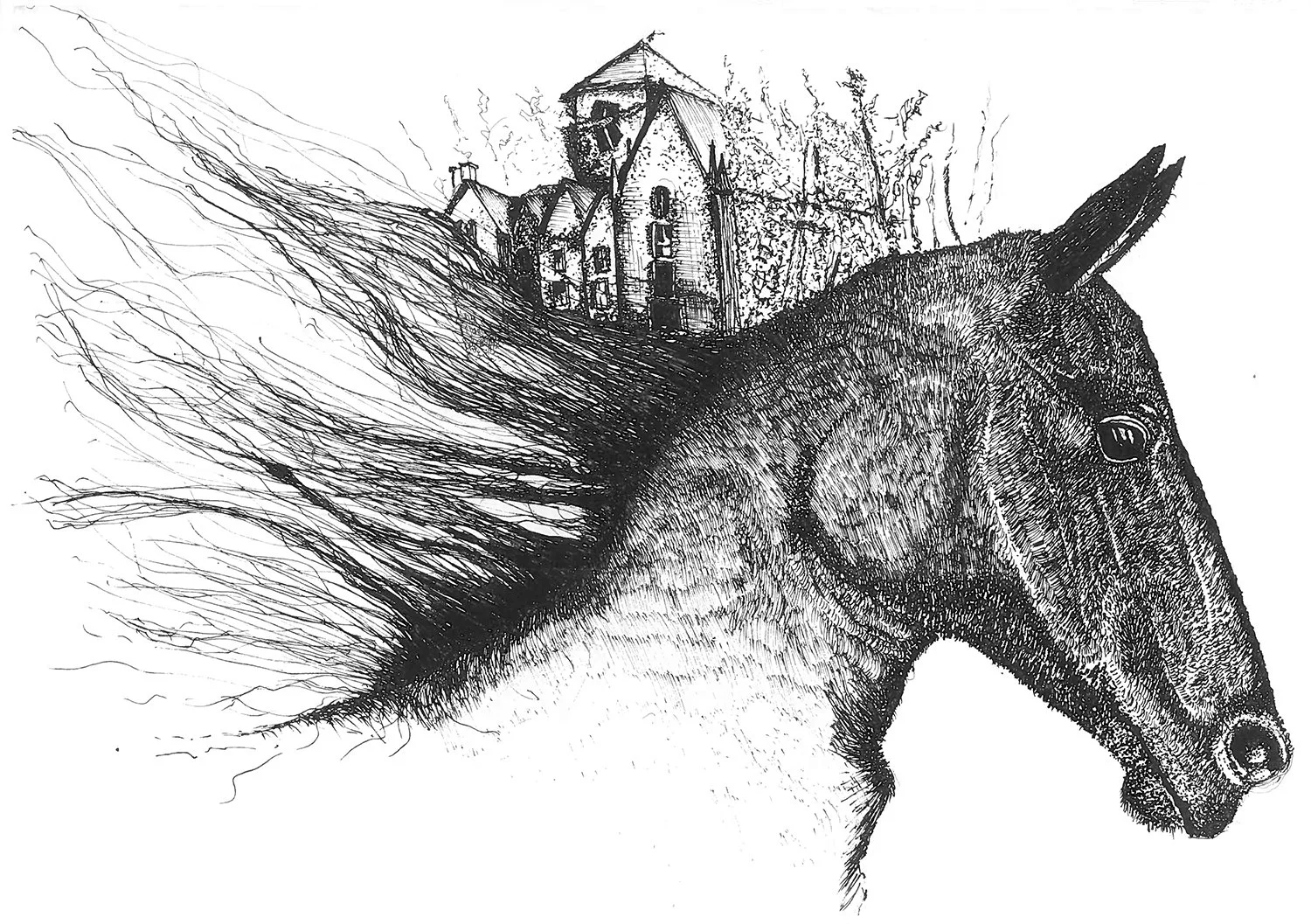
by Christopher Williams